
Designing homes for healthy cognitive ageing
The University of Stirling is a recognised leader in the field of ageing and dementia studies. Our research helps prepare for a future where more than 25% of the UK population will be over 65, many of whom will be living with a health condition that significantly impacts them on a day-to-day basis.
The University is home to the UK Research and Innovation funded project, Designing Homes for Healthy Cognitive Ageing (DesHCA), which provides innovations and solutions for housing to support healthy cognitive ageing. DesHCA, formed as part of the UKRI’s Healthy Ageing Challenge, provides a major resource for the public, practitioners and industry.
/filters:format(webp)/prod01/cdn/media/stirling/services/research/images/deshca-banner-1920X689.jpg)
Exploring supportive home design from every angle
Stirling experts on the DesHCA project investigated the issues around supportive home design and adaptations from many different perspectives and aimed to identify innovations that would be practical, affordable and scalable for housing developers and providers.
The project asked for input from older people at every stage of the process: from learning about what they need and want in their homes today, to asking about what they hope houses might look like in the future. The project also captured the expertise of builders, architects, and others in the construction industry, as well as professionals working in health and social care and local government. Together, the project team and partners considered a host of factors that influence the design of new houses and adaptation of existing homes to support healthy cognitive ageing.
The data DesHCA collected from older people and professionals sits alongside information drawn from large, well-established databases to help us understand the issues around supportive design on a national and international level.
DesHCA asked for input from older people and captured the expertise of industry professionals.

Tech and gadgets
are integral to age-inclusive home design, our research shows.

Serious games
like the UoS-developed board game Our House encourage better understanding of housing needs.

700+
people were consulted to develop DesHCA's practical checklist for an age-inclusive home.
Understanding the housing needs of older people
DesHCA used a wide range of methods to gather data on what makes a house as good as it possibly can be to support healthy ageing. Here are just some of the ways the information collected is being used to inform how houses are designed or modified:
Creative home mapping
DesHCA used a creative mapping method to explore how older people thought and felt about their homes. Participants created a map of their home that was meaningful to them, making it possible to capture a lot of data on what they liked and disliked, what worked well for them, and what they would ideally change in the future.
The research showed how subtle tweaks to a living space could make a big difference. It also helped identify the importance of spaces tailored to people's specific interests and personality, rather than a one-size-fits-all approach to house design for healthy ageing.
Dementia friendly home audit
The project team created an online audit to get an impression of how age-inclusive or dementia friendly people’s homes are. Over 400 people took part in the audit, which asked questions about key areas in and around the home, including how easy it was to recognise their front door and distinguish it from their neighbours, how easy it was to read settings on appliances, and how they used colour, contrast, and pattern throughout their home.
This gave the team a fantastic opportunity to learn about a wide range of houses in the UK and highlight key areas where homes might be improved or adapted at relatively low cost.
Putting technology to work
DesHCA used virtual reality (VR) to enable housing professionals and older people to experience house designs from a unique perspective. VR consultations gave participants a much more realistic, immersive look at DesHCA design proposals before giving their detailed feedback
The research showed that good age-inclusive house design should adapt to changing needs, offer ample storage spaces and include functional social areas to help combat social isolation. The team also used thermal imaging sensors to explore how subtle factors like changing temperature, light levels, or air quality can impact the way people use their homes.
Immediate impacts
The data collected by the DesHCA team is already helping to give a better understanding of issues around supportive house design and adaptation for healthy ageing. Since the project concluded in 2024, DesHCA's findings have had an impact in some of the following areas:
Informing national policy
DesHCA’s findings have been fed into the Older People's Housing Task Force Report, which is being used to inform the revision of the National Design Guide and National Model Design Codes. These guidelines are used in planning and regulating home design in England, which places DesHCA insights at the heart of Westminster current housing policy initiatives.
Professional guidance
The College of Occupational Therapy is now promoting DesHCA design advice to their 36,000 members UK wide. Likewise, the Housing Learning and Improvement Network - who are recognised by government as a sector leader in promoting good quality housing through the lens of an ageing population - is promoting DesHCA findings to its community of over 15,000 housing professionals in the UK.
International impact and collaboration
Watch: DesHCA Principal Investigator Professor Alison Bowes talks about the project during a visit from the King and Queen of Sweden to the University of Stirling.
Resources created as part of DesHCA are also being used internationally. DesHCA’s Tips and Tricks for creating a home that supports you booklet is being translated by partners such as the SilviaHemmet Foundation (Sweden) and Compagnons Bâtisseurs (France) to support their own work around design for healthy ageing. The SilviaHemmet Foundation was founded by Queen Silvia of Sweden to offer training programmes and care for those living with dementia and their families. Queen Silvia, an honorary graduate of the University, has twice visited our campus, including with her husband King Carl XVI Gustaf to tour our Dementia Services Development Centre, which features a permanent display of rooms adapted to support the particular needs of people living with dementia.
Our House: a serious game
The DesHCA project recognises the importance of people from different backgrounds with different needs and priorities coming together and exploring the challenges associated with designing homes for healthy cognitive ageing from different perspectives.
To facilitate this, the project team created Our House - a Serious Game based on empirical evidence. Co-designed with older people, it has been designed to help players not only listen to different views, but put themselves in the shoes of others to get a better understanding of how these different perspectives can shape every aspect of creating an age-inclusive home. Our House invites players to work through problems common to creating age-inclusive housing, such as how to balance the cognitive and physical impact of modifications alongside the changing needs of an older person.
The project invited policymakers and health officials to take part in the study, offering them more insight into the challenges older people can face with housing.
"The serious gaming of ageing encourages people to think differently about the concept of healthy ageing, both physically and cognitively, and has a positive knock-on effect on planning and policy making."
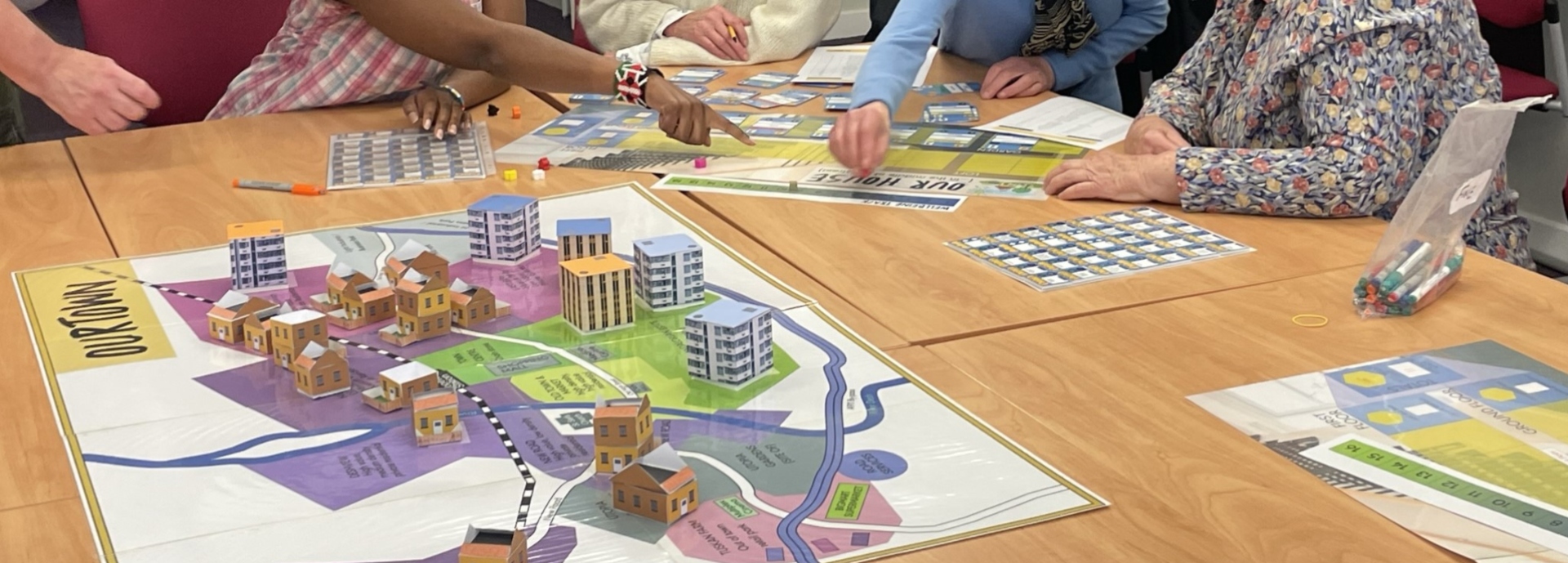
DesHCA's Our House Serious Game can help overcome the stigma that still exists around ageing, according to researchers.
Looking to the future
Although the DesHCA project concluded in 2024, its findings are playing a vital part in helping to inform good house design for the future. As well as now feeding into the UK Government’s National Design Guide and National Model Design Codes and gaining traction with professional bodies and charities, the project’s findings will underpin future research at the University of Stirling and beyond.
Among the major impacts DesHCA research is having is its role in informing the Intergenerational Living Innovation Hub: a multi-million pound research and development initiative established with £7.25m of UK government funding as part of the Stirling and Clackmannanshire City Region Deal.
The University of Stirling also continues to take the lead in other areas of healthy ageing through our work in the Centre for Environment, Dementia and Ageing Research (CEDAR), the Dementia Services Development Centre, and through partnerships and collaborations – such as hosting Scottish Housing Day in 2024, and a summit on Healthy and Sustainable Housing for the Ageing Population in 2025.
DesHCA research will help shape the Intergenerational Living Innovation Hub - a multi-million pound research and development platform funded as part of the Stirling and Clackmannanshire City Region Deal.
Stirling housing experts talk about 'homes for life' - the theme of the 2024 Scottish Housing Day.

Find out more about DesHCA, access resources and read about next steps in the project by visiting the DesHCA website.
/filters:format(webp)/filters:no_upscale()/prod01/cdn/media/stirling/services/research/images/our-town-serious-game-578X358.png)
/filters:format(webp)/filters:no_upscale()/prod01/cdn/media/stirling/services/research/images/king-and-queen-of-sweden-578X358.png)
/filters:format(webp)/filters:no_upscale()/prod01/cdn/media/stirling/services/research/images/accessible-housing-story-578X358.jpg)
Related people
Read more about members of the DesHCA research team.
Related publications
Learning about design for dementia: lessons from a Japan–UK network
Bowes A, Dawson A, Copland F, Gibson G, Hotta S, Ishikawa S, Ito M, Kiuchi D, Koreki A, Lovatt M, McCall V, Palmer L, Quirke M, Phillips J & Rutherford A (2024) Learning about design for dementia: lessons from a Japan–UK network. Cogent Gerontology, 3 (1). https://doi.org/10.1080/28324897.2024.2397951
Othering Older People’s Housing: Gaming Ageing to Support Future-Planning
McCall V, Rutherford AC, Bowes A, Jagannath S, Njoki M, Quirke M, Pemble CM, Lovatt M, Maginn K, Davison L, Scrutton P, Pengelly R & Gibson J (2024) Othering Older People’s Housing: Gaming Ageing to Support Future-Planning. International Journal of Environmental Research and Public Health, 21 (3), Art. No.: 304. https://doi.org/10.3390/ijerph21030304
Bowes A, Davison L, Dawson A, Pemble C, Quirke M & Swift S (2023) Housing Design Evaluation Research for People Living with Cognitive Change: A Systematic Literature Review. Journal of Aging and Environment. https://doi.org/10.1080/26892618.2023.2223589
Scaling home designs for healthy cognitive ageing: a realist evaluation perspective
Bowes A, Jagannath S, Njoki M, Quirke M, Davison L, Dawson A, Pemble C. (2025) Scaling home designs for healthy cognitive ageing: a realist evaluation perspective Social Science and Humanities Open https://doi.org/10.1016/j.ssaho.2025.102186